The thigh is the region where partial treatment shows most clearly. Remove fat from the inner side only and the saddle bulge on the outside becomes the widest point of the leg; treat the outside alone and the knees look heavier. Our standard plan is a 360-degree approach covering inner, outer, front, back and the saddle, so the line runs uninterrupted from hip to knee.
The operation takes about three hours under sedation. The cuts sit near the tailbone and in the crease behind the knee. The long cannula reaches the whole thigh from those two points, so there are no marks down the side of your leg.
What is thigh liposuction?
Thigh liposuction removes the subcutaneous fat of the thigh through cuts near the tailbone and in the crease behind the knee. Our standard plan treats the inner, outer, front and back together with the saddle, so the leg reads as one line from hip to knee.
It shapes the leg rather than reducing its size everywhere. Treating one side alone tends to make the untreated side the widest point, which is the most common reason a thigh result looks unfinished.
Why treat the thigh all the way around?
- The gap between the thighs and the width at the saddle are set by different regions, and both have to move for the leg to look longer
- Fat harvested from the thigh is high-quality donor material for hip grafting, which balances the pelvis in the same session
- Incisions are hidden at the tailbone and knee crease rather than on the visible outer thigh
- Cellulite dimpling is assessed honestly - suction improves contour but does not erase surface texture
Am I a good candidate for thigh liposuction?
Your thighs are disproportionate to your upper body, the fullness is soft fat rather than muscle, and your skin retracts when released. Patients whose thighs touch while standing with feet together, and those whose saddle region has resisted years of training, see the clearest change.
If the thigh is largely muscular, suction will not reduce it, and if skin quality is poor after major weight loss a thigh lift is the operation that matches your goal. We say which one you need at the consultation.
Which areas does thigh liposuction treat?
- Inner thigh, upper third, where contact occurs while walking
- Saddle region on the outer thigh, blended into the hip and buttock crease
- Front of the thigh, where trousers pull across the front
- Back of the thigh and the banana fold under the buttock
- Inner knee, treated so the leg line does not stop above the joint

How is thigh liposuction performed?
01. Standing marking
The leg is marked standing and walking, because the saddle bulge changes with posture.
02. Sedation
Triple low-dose sedation with continuous monitoring by an anesthesiology specialist.
03. Posterior and saddle
Suction begins at the back and outer thigh through the tailbone incision.
04. Inner thigh and knee
Position is changed to complete the inner thigh and inner knee through the knee-crease incision.
05. Grafting or closure
Harvested fat is processed with stem cells for hip grafting if planned; incisions are sutured.
How long is recovery after thigh liposuction?
| Time after surgery | What to expect |
|---|---|
| Day 1 to 3 | Compression full-time, walking is stiff, first aftercare session |
| Day 4 to 7 | Desk work resumed, sutures out on day 7 |
| Week 2 to 4 | Bruising clears from the top down; standing all day is comfortable again |
| Month 2 to 3 | Inner thigh swelling resolves last |
| Month 4 to 6 | Final leg line assessed and photographed |
What results can I expect from thigh liposuction?
Patients usually notice trousers fitting at the thigh within a month, while the visual leg line appears between month two and month four. Because the lower body drains slowly, thigh cases hold swelling longer than the abdomen - a fact worth knowing before you judge your result at week three.

What aftercare do I need after thigh liposuction?
- Compression garment full-time for three days, then daytime wear for six to eight weeks
- Walking hourly from day one to protect circulation on long-haul recovery
- Two aftercare sessions included; lymphatic care is particularly useful for the lower body
- Avoid long periods of sitting still in the first two weeks, including long flights
What are the risks of thigh liposuction, and how do we reduce them?
Thigh liposuction carries the standard risks of bleeding, inflammation, infection, prolonged swelling, temporary numbness, asymmetry and an uneven surface, and the lower body is more prone than the torso to lingering swelling.
- Suction depth is kept away from the superficial plane, where dimpling and waviness originate
- Both legs are compared during the operation, standing marks intact, rather than at the end
- Early mobilisation and compression are enforced to reduce the risk of blood clots
- An anesthesiology specialist monitors throughout, with a code blue pathway and hospital transfer agreements
Thigh liposuction or a thigh lift - which suits my skin?
| Thigh liposuction | Thigh lift | Weight loss | |
|---|---|---|---|
| Treats | Localised fat | Loose skin and fat | Overall body fat |
| Changes proportion | Yes, permanently | Yes | Rarely at the saddle |
| Scar | 3 to 5mm, hidden | Groin or inner thigh | None |
| Downtime | 5 to 7 days | 2 weeks | None |
| Best for | Good skin elasticity | Post-weight-loss laxity | Elevated body fat |
What do thigh liposuction results look like?
Cases from our own archive, photographed in the clinic and published with written consent. Each caption says how long after surgery the photo was taken.
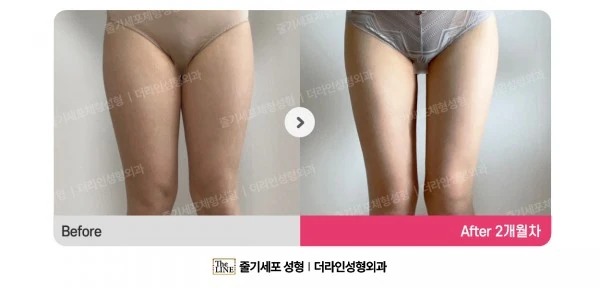
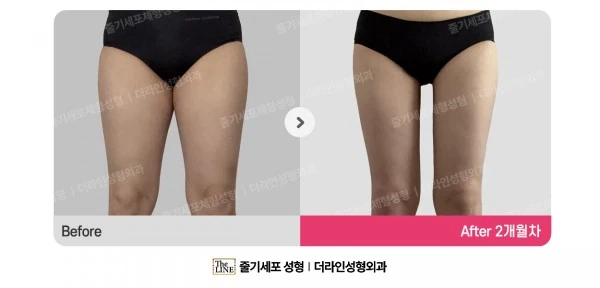
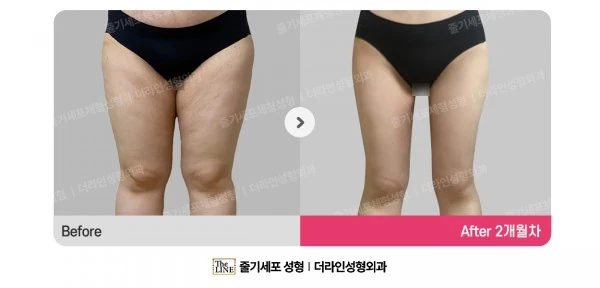
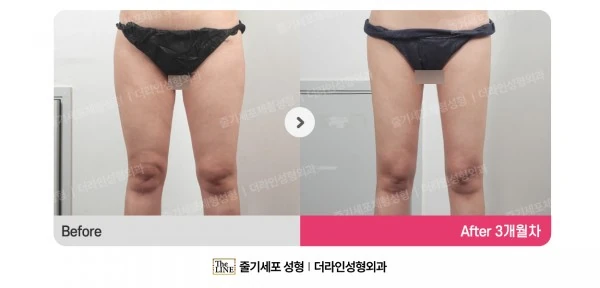
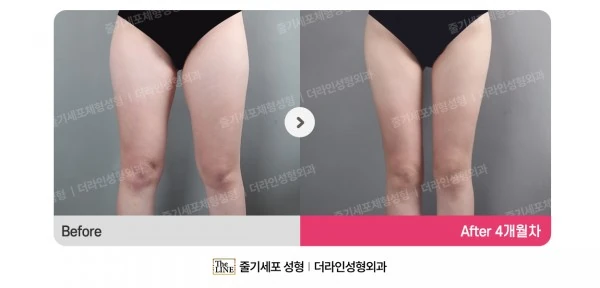
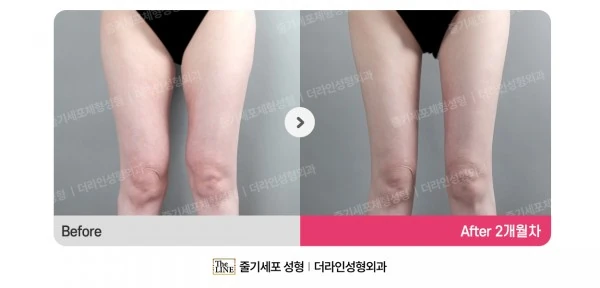
Outcomes differ from person to person, and side effects such as inflammation, bleeding and infection are possible. These are individual patients, not averages.
Thigh Liposuction in Seoul: more questions
It improves the contour that makes cellulite obvious, but the dimpling itself is caused by fibrous bands between skin and muscle and will not disappear. We say this before surgery rather than after, and we treat texture separately where it matters to you.
Yes, and it is common. We keep the fat taken from your saddle area and the back of the thigh, separate its stem cells, and place it into the hip dip in the same operation. That widens the gap between hip and thigh, with no second recovery period.
One week in Seoul is enough. Two clinic visits, no hospital stay, and you can travel from two to three days after surgery, with an optional check-up first. Lower body cases do benefit from a few extra days of walking in compression, so build in a buffer if your schedule allows.
A thigh plan covers a 360-degree field over a longer limb, requires a position change during surgery and takes about three hours. The price reflects operating time and field size rather than the volume of fat removed.
Thighs hold swelling longer than any other area except calves, so you need patience for three to four months. Patients who wanted a straighter leg line rather than a smaller number on the scale tell us it was worth it.
Nobody can claim that honestly. Ask whether the plan treats the leg all the way round or only the inner side, where the cuts are placed, and whether the knee is included. Those three answers decide whether the leg reads as one line.