A full male chest usually has two parts, and they behave differently. The soft fat around the outside responds to suction. The firm, rubbery disc of breast gland tissue right under the nipple does not. Leaving that disc behind is why so many men still feel a lump after chest liposuction elsewhere. A proper plan deals with both.
Our male package covers chest, abdomen and love handles - the three regions that create the upper body line together - at about two hours per region under sedation. Access is through the armpit, with an incision at the edge of the areola added only when glandular excision is required.
What is male chest liposuction, and is it the same as gynecomastia surgery?
Male chest liposuction removes the fat layer of the chest through small cuts at the border of the areola and in the fold underneath. It flattens the chest line and the transition into the armpit.
Gynecomastia is the enlargement of glandular tissue rather than fat. Suction alone reduces fat; where firm glandular tissue is the cause, it is removed directly in the same operation. Which of the two you have is assessed by examination, not from a photograph alone.
Why is male chest liposuction planned differently?
- Male fat is denser and more fibrous than female fat, which changes cannula choice and operating time
- Glandular tissue under the areola must be excised, not suctioned, or a firm disc remains
- Chest, abdomen and flank are judged together, because a treated chest above an untreated waist reads oddly
- Skin retraction over the male chest is generally good, which favors suction over cutting surgery in most cases
Am I a good candidate for male chest liposuction?
Your weight has been stable, the fullness has been present for more than a year, and any underlying hormonal or medication-related cause has been considered. Men between their twenties and fifties with a soft chest contour and good skin tone are the usual candidates.
Recent onset, unilateral change, pain or discharge require investigation before any cosmetic surgery is planned. We will refer rather than operate.
Which areas does male chest liposuction treat?
- Chest, across the whole pectoral region rather than only the lower border
- Areolar region, where breast gland tissue is excised if present
- Armpit fold and the roll that spills over the side of the chest
- Abdomen and flanks, usually included so the upper body line is continuous
- Optional definition work along the abdominal midline for patients with low body fat

How is male chest liposuction performed?
01. Standing marking
Chest, fold and abdominal transitions are drawn while you stand.
02. Sedation
Triple low-dose sedation managed by an anesthesiology specialist.
03. Armpit access
A 3 to 5mm incision inside the armpit serves the chest and the fold.
04. Suction and excision
Fat is suctioned across the pectoral region; breast gland tissue is excised through an incision at the edge of the areola where present.
05. Stem cells and closure
The stem cells go back in, the incisions are sutured and a compression vest is fitted.
How long is recovery after male chest liposuction?
| Time after surgery | What to expect |
|---|---|
| Day 1 to 3 | Compression vest full-time; reaching overhead is limited |
| Day 4 to 7 | Desk work resumed, sutures out on day 7 |
| Week 2 to 4 | Bruising clears; shirts fit differently across the chest |
| Week 4 to 6 | Upper body training resumed progressively |
| Month 3 to 6 | Final chest line assessed |
What results can I expect from male chest liposuction?
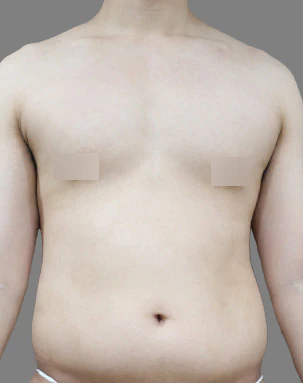
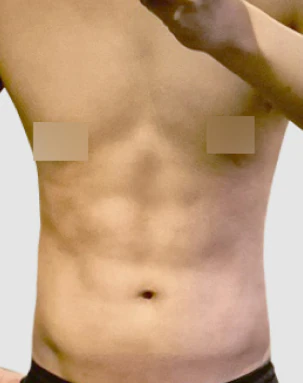
The chest flattens visibly within a month, while the area around the areola stays firm longer where excision was performed. Most men report the difference first in fitted shirts and in photographs taken from the side. Skin over the male chest generally retracts well, so a smooth result from suction alone is realistic for the majority.
What aftercare do I need after male chest liposuction?
- Compression vest full-time for three days, then daytime wear for four to six weeks
- No chest or overhead training for four weeks; walking and lower body work earlier
- Two aftercare sessions included, with additional care where firmness persists around the areola
- Expect residual firmness under the areola for up to three months after glandular excision
What are the risks of male chest liposuction, and how do we reduce them?
Bleeding, a pocket of blood, inflammation, infection, altered nipple sensation, asymmetry, contour irregularity and a depression under the areola from removing too much are the recognized risks.
- A deliberate layer is left under the areola, because an inverted crater is harder to correct than residual fullness
- Excision is performed under direct vision through the edge of the areola, not blindly with a cannula
- Both sides are compared during surgery with the patient semi-upright
- Anesthesia is specialist-managed with continuous monitoring and a code blue pathway
Does gynecomastia need surgery, or will weight loss do it?
| Suction alone | Suction with excision | Weight loss | |
|---|---|---|---|
| Treats | Fatty fullness | Fat plus glandular disc | Overall body fat |
| Scar | Armpit only | Armpit and areolar border | None |
| Downtime | 5 to 7 days | 7 days | None |
| Resolves the firm disc | No | Yes | No |
What do male chest liposuction results look like?
Cases from our own archive, photographed in the clinic and published with written consent. Each caption says how long after surgery the photo was taken.
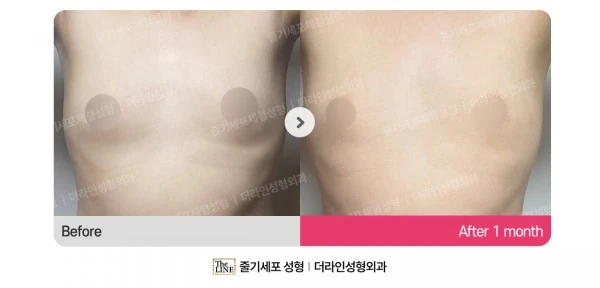
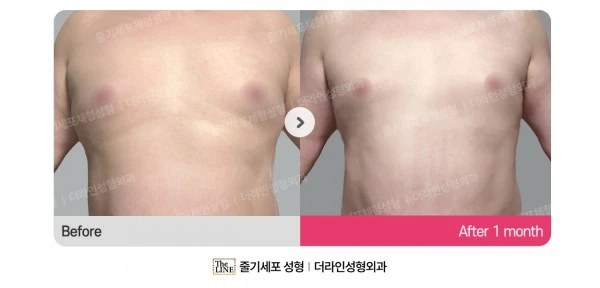
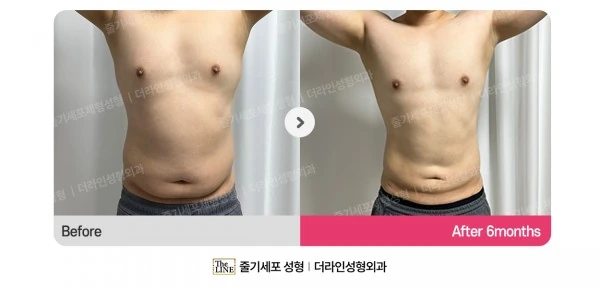
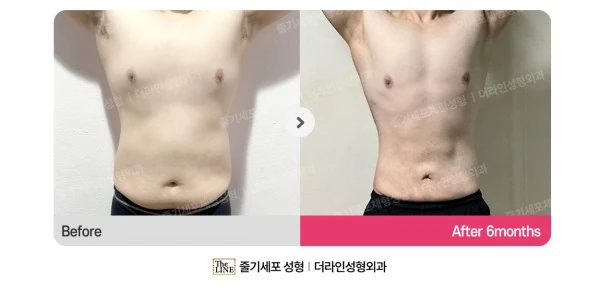
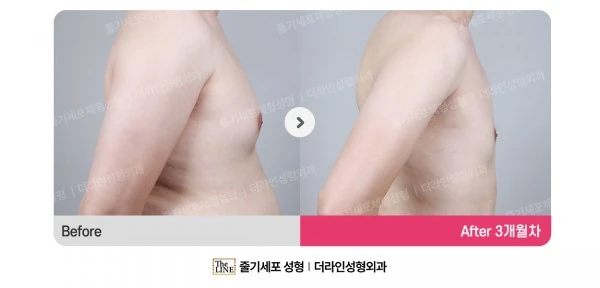
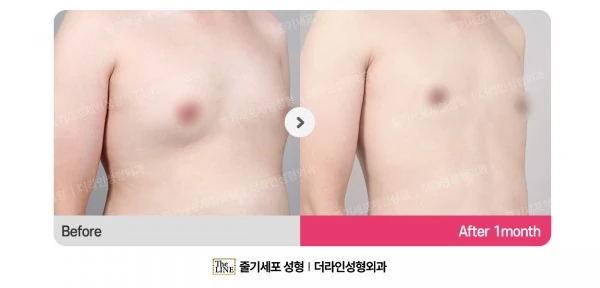
Outcomes differ from person to person, and side effects such as inflammation, bleeding and infection are possible. These are individual patients, not averages.
Male Chest Liposuction in Apgujeong: more questions
A firm, rubbery disc directly under the areola that feels distinct from the surrounding softness usually indicates gland. We confirm on examination, and where gland is present we plan excision alongside suction rather than promising suction will handle it.
The armpit incision is three to five millimeters and hidden in a crease. Where excision is required, an additional incision follows the lower areolar border, where the color change conceals it.
Lower body training from week two, chest and overhead work from week four, and full-intensity training from week six. Compression is worn during training for the first month.
Either works. Chest-only surgery is a shorter operation, but most men are judged from the side, where the chest and waist are seen together. We will show you both plans and let you choose.
For a chest that has been full for more than a year at a stable weight, yes. The part that changes a man's shirt line is removing the gland disc as well as the fat, and that is a surgical decision, not a gym one.
No clinic can honestly claim that. What separates them is whether glandular tissue is assessed by examination rather than from photographs, and whether the surgeon removes gland directly when suction alone would not flatten the chest.
Yes. A male body plan commonly treats the chest, abdomen and flanks together, and abdominal definition is planned inside that rather than as a separate procedure.